A Solana meme coin can launch in minutes. Getting people to care about it is a different challenge.
A token may have a recognizable name, an eye-catching logo, and an active X account, yet struggle to attract meaningful attention. The team keeps posting, the chat stays quiet, and every new announcement seems to disappear beneath the next wave of launches.
When that happens, the immediate temptation is to post more, spend more, or make bigger promises. Sometimes, though, the problem is not a lack of activity. It is how the project is approaching marketing in the first place.
In a crowded market, small mistakes can make a real difference. An unclear story, a poorly targeted campaign, or a community full of unanswered questions can weaken the impression a project makes on new visitors.
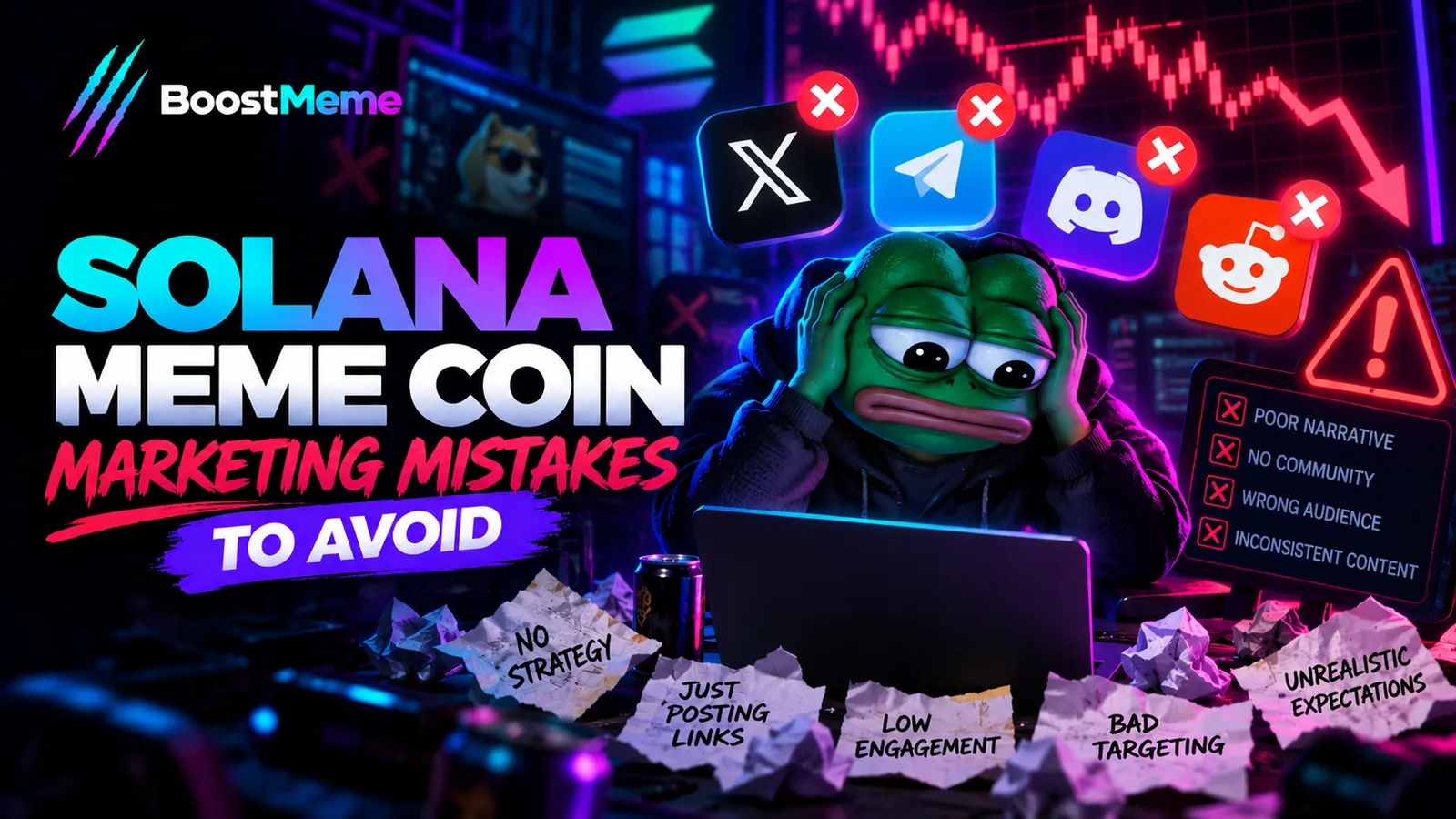
Here are the most common Solana meme coin marketing mistakes to avoid—and what to do instead.
1. Launching a Token Without a Marketing Plan
Creating a token and preparing it for discovery are two different tasks.
Some teams spend nearly all their time preparing the launch itself. They choose a name, create a logo, deploy the token, and publish the contract address. Once the coin is live, they expect traders to find it.
But a launch does not automatically create awareness. New tokens compete for attention, and people need a reason to notice one project instead of another.
Without a basic marketing plan, the team may end up making decisions on the fly: posting random memes one day, announcing vague milestones the next, and trying an unrelated promotional service when engagement slows.
What to do instead
Prepare a simple launch and post-launch plan before promotion begins.
Decide what makes the project recognizable, who might find its narrative interesting, where those people are active, and what information a newcomer needs to evaluate the project.
Make sure the official website, social profiles, token mint address, and community links are consistent. Then establish a realistic content schedule and decide how you will evaluate the campaign.
You do not need a complicated marketing department to do this well. Even a short written plan gives the team a clearer direction.
If you are still working through the launch process itself, our guide, Pump.fun vs. Raydium: How Solana Meme Coin Launches Work, explores the mechanics of launching a Solana meme coin.
2. Giving People a Token but No Story to Remember
In meme coin culture, the story often helps people decide whether a project is interesting enough to follow.
A ticker symbol and a contract address tell people which token they are looking at. They do not necessarily explain why the project exists as a meme, what its identity is, or what makes its content distinctive.
Consider two hypothetical projects.
The first repeatedly announces that its token has launched and asks people to buy. The second has a recognizable character, an original running joke, a consistent visual identity, and a narrative that can inspire new memes.
Neither approach guarantees attention or success. But the second gives its community more material to work with.
What to do instead
Develop a concise project narrative that the team can communicate consistently.
Ask yourself three questions:
- What is the central idea, character, or joke behind the project?
- What makes that idea interesting or recognizable to the intended audience?
- How can the community express that idea through original content?
Your story does not need to be elaborate. A simple, memorable concept can be more useful than a long explanation filled with crypto buzzwords.
The key is to make the project easy to understand and give people something they can reinterpret, share, or build upon.
A good narrative also makes promotional content more coherent. Instead of simply distributing the same contract address, the team can communicate an actual idea.
3. Treating Every Post Like a Sales Pitch
Crypto timelines are full of urgent calls to buy, exaggerated claims, price predictions, and variations of the same promotional message.
When every post from a project says some version of “buy now,” people have little reason to follow its account unless they are already interested in the token.
Worse, aggressive language can make a project look less credible, especially when the claims are unsupported.
A project does not become more compelling simply because its promotional copy uses more capital letters or promises a larger return.
What to do instead
Give your content different purposes.
Some posts can introduce the narrative. Others can entertain, share a genuine update, showcase community creations, or answer questions. Promotional posts still have a role, but they should fit into a broader communication strategy.
For example, a project built around a humorous character could publish an original meme about a familiar crypto experience, followed by a post introducing the character and another sharing the community's variations.
Each post contributes something different to the same identity.
Be particularly careful with claims about future prices, guaranteed returns, exchange listings, partnerships, or expected demand. Only make factual claims that you can substantiate, and never present speculation as confirmed information.
Trust is difficult to build when the project repeatedly promises more than it can demonstrate.
4. Chasing Views and Likes Instead of Meaningful Attention
A post receives thousands of impressions. The team celebrates the numbers, but very few people visit the website, ask questions, follow the project, or return for later updates.
Was the post successful?
It depends on what the team wanted it to achieve.
Visibility can be useful, but not all attention has the same value. A viral joke may entertain people who have no interest in the project, while a smaller post may attract more relevant conversations.
Neither impressions nor follower counts, by themselves, establish that a campaign has built lasting interest.
What to do instead
Decide what you are trying to measure before publishing or promoting content.
For a discovery campaign, you might examine impressions, profile visits, referral traffic, and visits to official project pages. For community building, you might look at substantive discussions, returning participants, and original content created by members.
For a specific campaign, track the results available to you and compare them over a consistent period.
Avoid purchasing fake followers, manufacturing engagement, or coordinating deceptive activity to make a project look more popular than it is. Artificially inflated numbers can obscure weak performance and undermine credibility.
The useful question is not simply how many people saw a post. It is what the available evidence suggests they did next.
5. Posting Everywhere Without Understanding the Audience
An X post, a Telegram announcement, a Discord discussion, and a Reddit contribution do not serve identical purposes.
Yet some teams distribute the same promotional text across every platform, often with little regard for context. The post may be irrelevant to the discussion, poorly suited to the format, or prohibited by the community's rules.
Publishing more copies of the same message does not automatically expand meaningful reach.
What to do instead
Understand the role each platform can play before deciding how to use it.
X can help introduce a project through public posts, relevant conversations, and original content.
Telegram can provide a direct channel for announcements, updates, and ongoing member interaction.
Discord can support a more organized community when there are enough active members to justify dedicated discussion spaces, events, or collaboration.
Reddit can offer opportunities to contribute to topic-focused discussions, but individual subreddits set their own expectations and restrictions on promotion.
Read the applicable rules, adapt content to its context, and contribute something relevant rather than treating every community as an advertising board.
Also resist the urge to open every possible channel immediately. Maintaining two relevant platforms properly is often more practical than spreading a small team's attention across six neglected accounts.
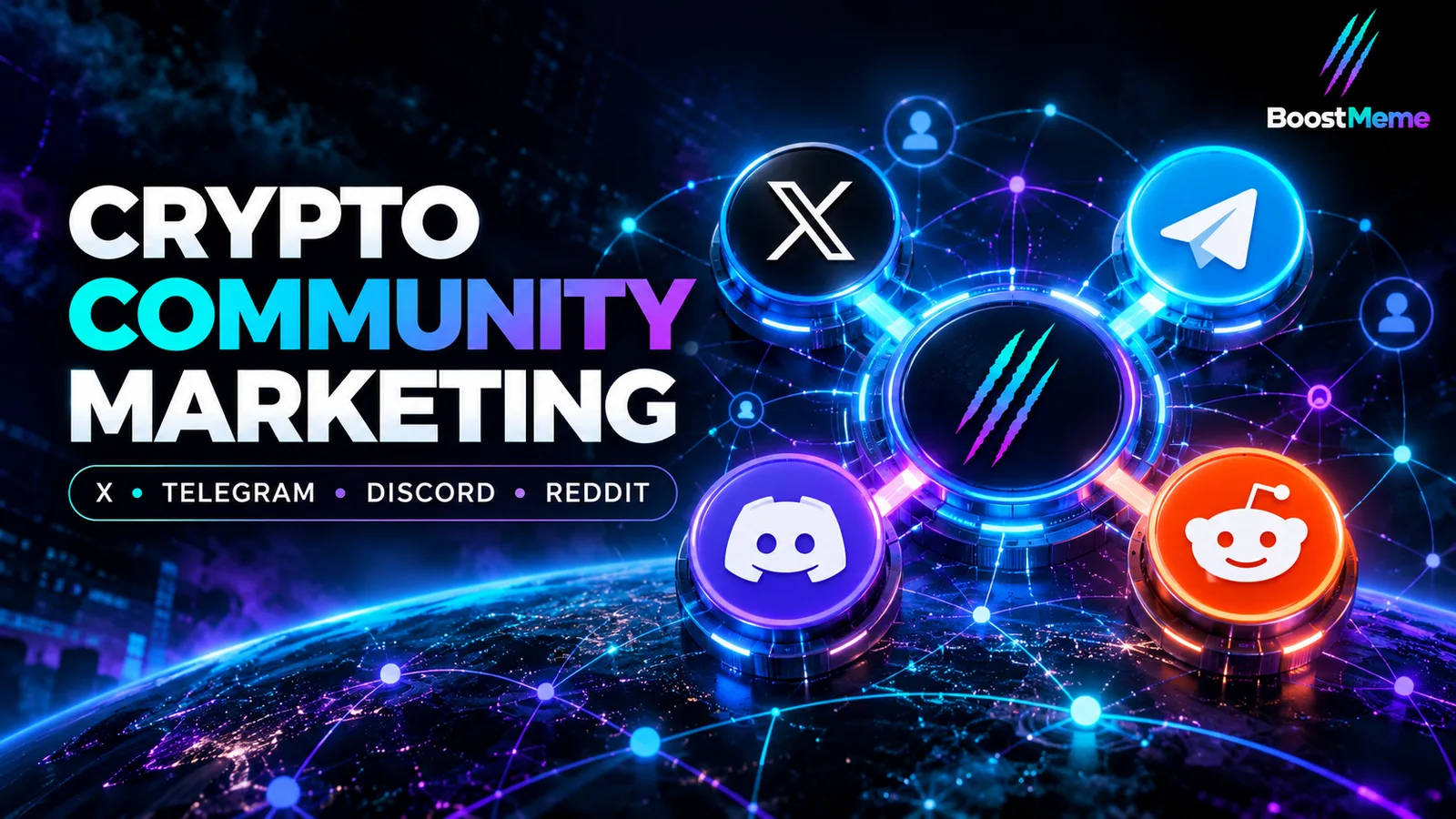
For a deeper look at platform-specific strategy, see our guide, Crypto Community Marketing: X, Telegram, Discord and Reddit.
6. Ignoring the Community Once the Promotion Ends
A promotional post brings new people to a project's social profile or chat. They look around, find outdated information, encounter unanswered questions, or struggle to work out which links are official.
Some leave without engaging. Others may become confused about the project's status.
This is a common gap in marketing: teams prepare to attract attention but give too little thought to what people experience after arriving.
Promotion can create an opportunity for discovery. What happens after discovery still matters.
What to do instead
Before a campaign begins, make sure someone is responsible for keeping the project's public information accurate and its community channels reasonably well maintained.
Pin important links. Keep announcements clear. Respond to genuine questions when possible, and explain where members can find official information.
Do not manufacture constant activity simply to make a group look busy. A smaller community with useful conversations may provide a better experience than a large chat filled with repetitive messages.
Security also deserves attention. Crypto communities can attract impersonators and fraudulent links. Establish clear official channels, make it easy to identify them, and respond promptly when suspicious activity is reported.
The aim is to give people who discover the project a reliable way to understand it and decide whether they want to stay involved.
7. Choosing Promotion Based on Price Alone
Paid promotion can be useful when a project wants to extend its reach beyond its existing audience. But not every campaign provides the same type of exposure, duration, or distribution.
One service may offer a placement on a website. Another may distribute promotional content through social channels. A more coordinated campaign may combine placement with outreach to relevant crypto audiences.
Comparing these options solely by price can lead to the wrong decision.
A cheaper option is not necessarily the best fit, and a more expensive campaign is not automatically more effective for every project.
What to do instead
Begin with the project's immediate objective.
Are you looking for an initial opportunity to be discovered? Do you want promotional placement combined with X content? Or are you looking for a broader campaign involving multiple crypto communities?
Then review what each service actually includes, how long the campaign runs, which channels are involved, and what information you need to supply.
Ask how the campaign will be executed rather than relying on vague descriptions such as “massive exposure” or “guaranteed viral growth.”
A useful promotional service should explain its deliverables clearly and avoid promising outcomes it cannot control.
This is particularly important for meme coins, where audience interest, market conditions, project credibility, and the quality of the content can all affect the response.
8. Expecting Promotion to Fix Every Problem
A token is receiving little attention, so the team pays for promotion. The campaign runs, but the token does not attract the interest the team expected.
It is easy to conclude that promotion does not work.
But consider what a new visitor might encounter: an unclear narrative, missing project information, inconsistent branding, broken links, or a community that cannot answer basic questions.
More exposure can bring more opportunities for people to encounter the project, but it does not remove those weaknesses.
Nor does it guarantee that visitors will become community members, traders, or buyers.
What to do instead
Treat promotion as one component of a wider marketing strategy.
Before launching a campaign, review your project's presentation from the perspective of someone who has never heard of it. Can they identify the official account? Understand the central idea? Find the correct token information? Learn where to follow updates?
Make it easy for an interested person to investigate the project without having to piece together its identity from unrelated posts.
Then coordinate promotional activity with useful content and an active, well-maintained official presence.
Promotion can help create additional opportunities for discovery. What happens after that depends on many factors, including the project, its message, the audience reached, and broader market conditions.
9. Making No Effort to Learn From Previous Campaigns
Some teams repeat the same marketing activity week after week because it is familiar. Others change direction after every disappointing post.
Both approaches make it difficult to understand what is actually helping.
Without consistent measurement, decisions become driven by impressions, anecdotes, or the latest reaction from the community rather than evidence.
What to do instead
Set a small number of clear objectives for each campaign.
You might want to increase qualified website visits, test which narrative attracts more meaningful engagement, or understand which channel sends people to your official pages.
Use tracked links and UTM parameters where appropriate. Review social analytics and website data, while remembering that some messaging apps and platforms do not provide complete referral information.
After each campaign, ask:
- Which channels produced the most relevant engagement?
- Which messages prompted genuine questions or further exploration?
- Where did people encounter friction or confusion?
- What should remain the same, and what should change next time?
Do not judge a strategy solely by one post or a brief period of market activity. Look for patterns across comparable campaigns, and be honest when the data is incomplete.
The point of measurement is not to make every campaign look successful. It is to make the next decision better informed.
10. Forgetting That Credibility Is Part of Marketing
In crypto, people often encounter a project before they know who runs it, how it operates, or which information to trust.
That makes consistency and transparency especially important.
An incorrect token address, a misleading partnership announcement, an unexplained change in official links, or contradictory claims across social profiles can damage confidence. Such mistakes can also expose community members to impersonators and scams.
A polished logo cannot compensate for unreliable information.
What to do instead
Keep the project's identity and official information consistent across its website and social channels. Verify important claims before publishing them, and correct mistakes clearly when they occur.
Explain what is known, distinguish plans from completed work, and do not use promotional content to create a misleading impression of endorsements, partnerships, market demand, or future performance.
In a fast-moving market, accurate communication is more useful than inventing an announcement simply to maintain attention.
Credibility does not guarantee that a meme coin will gain traction, but poor communication can create avoidable barriers for people trying to evaluate it.
A Practical Checklist Before Your Next Campaign
Before spending time or money on promotion, work through this short checklist.
- Project identity: Is the narrative clear, memorable, and consistent?
- Official information: Are the website, social accounts, token mint address, and community links accurate?
- Content: Do your posts offer something beyond a request to buy or trade?
- Audience: Are you targeting relevant communities and following their rules?
- Community readiness: Can new visitors find useful information and get basic questions answered?
- Campaign fit: Do you understand the placement, duration, channels, and deliverables included in the promotional service?
- Measurement: Have you decided which available metrics will help you evaluate the campaign?
- Expectations: Are your goals realistic, without promises of guaranteed buyers, returns, or price performance?
You do not need to perfect every aspect of marketing before taking action. The checklist is there to catch avoidable problems and help you spend your effort more deliberately.
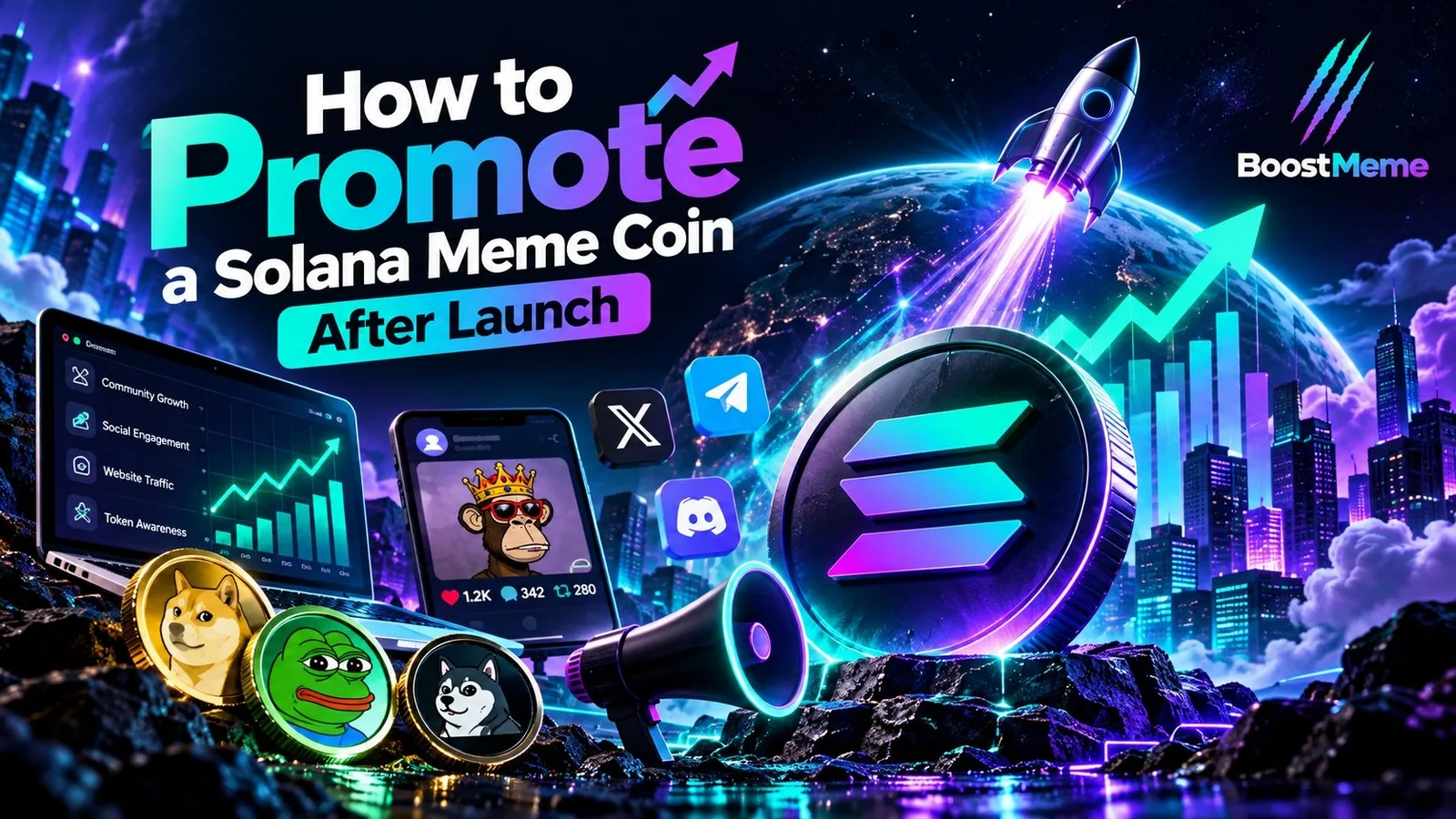
For a broader walkthrough of the work that follows a launch, read How to Promote a Solana Meme Coin After Launch. The key is to connect preparation, content, community engagement, and promotion rather than relying on any one of them in isolation.
How BoostMeme Can Support Your Promotional Strategy
Once your project is ready to receive attention, the next question is how to introduce it to people beyond the audience you already have.
BoostMeme is built specifically for Solana meme coins
combining promotional placement on our platform with campaign-based content distribution and outreach to relevant crypto audiences.
Instead of treating every campaign as the same service, BoostMeme offers different options for different promotional needs.
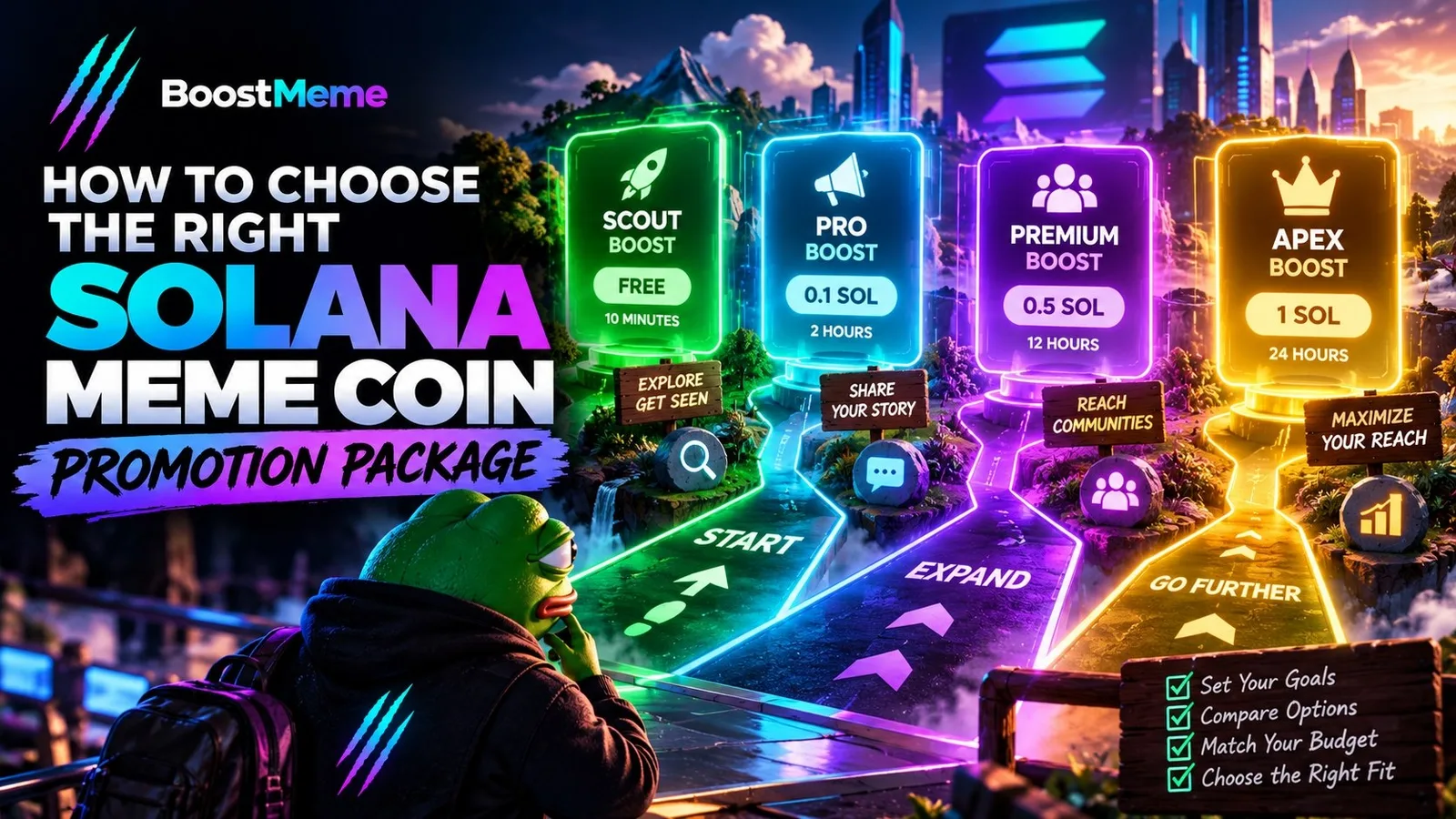
Scout Boost — Free, 10 Minutes
Scout Boost provides an opportunity for your token to appear in the Currently Boosted section while visitors explore the platform. It offers an entry point for projects that want to try promotional placement without paying for a campaign.
Placement priority may be lower than paid campaigns, especially during periods of high demand.
Pro Boost — 0.1 SOL, 2 Hours
Pro Boost combines promotional placement with narrative-focused promotional posts on X. It is an option for projects looking to introduce their central idea through a focused campaign.
Premium Boost — 0.5 SOL, 12 Hours
Premium Boost provides a longer campaign period with promotional placement and coordinated outreach involving participating crypto influencers, traders, relevant crypto communities, and Telegram call channels.
Apex Boost — 1 SOL, 24 Hours
Apex Boost offers a broader coordinated campaign across X, Reddit, Discord, and Telegram. Promotional content is distributed at intervals and tailored to the token's identity and relevant crypto audiences.
For all four packages, the selected campaign duration covers both the Currently Boosted placement and the scheduled promotional campaign. Individual social posts may remain visible after the campaign ends, depending on the platform.
The right choice depends on your goals, budget, and the kind of promotional activity your project needs. Before starting, prepare accurate official links, a clear narrative, and the information needed to communicate your project consistently.
Explore BoostMeme to learn more about promoting your Solana meme coin.
No promotional package can guarantee buyers, trading volume, token price increases, or viral reach. The purpose is to create additional opportunities for discovery and communicate a project's narrative to relevant audiences—not to determine how the market will respond.
Final Thoughts
Most meme coin marketing mistakes do not come from a single bad post. They develop when teams rely on assumptions instead of understanding their audience, rush into campaigns without preparation, or confuse visible activity with meaningful progress.
A clear story, useful content, reliable information, relevant community participation, and careful campaign planning can help a project avoid many of those problems.
Start with the basics. Understand what your project wants to communicate, make it easy for people to investigate, and choose promotional activities that support your actual goals. Review the results and change course when the evidence suggests that something is not working.
There is no formula that guarantees a meme coin will succeed. But there is a difference between throwing attention at a token and approaching its marketing with a deliberate strategy.
Your Meme. Built to Be Seen.
Further Reading
For more practical guidance, explore these guides from the BoostMeme blog: